

The diagnostic, run on SME lending · Book this week
Your SME lending workflow, mapped. Sixty minutes, free.
One call with the team that built and runs AI credit decisioning at ProCredit Bank. You walk us through how an SME application moves today — intake, documents, analysis, committee, disbursement. We tell you which steps AI can take off your analysts' desks, which ones should keep a person on them, and what the first one would cost to put into production.
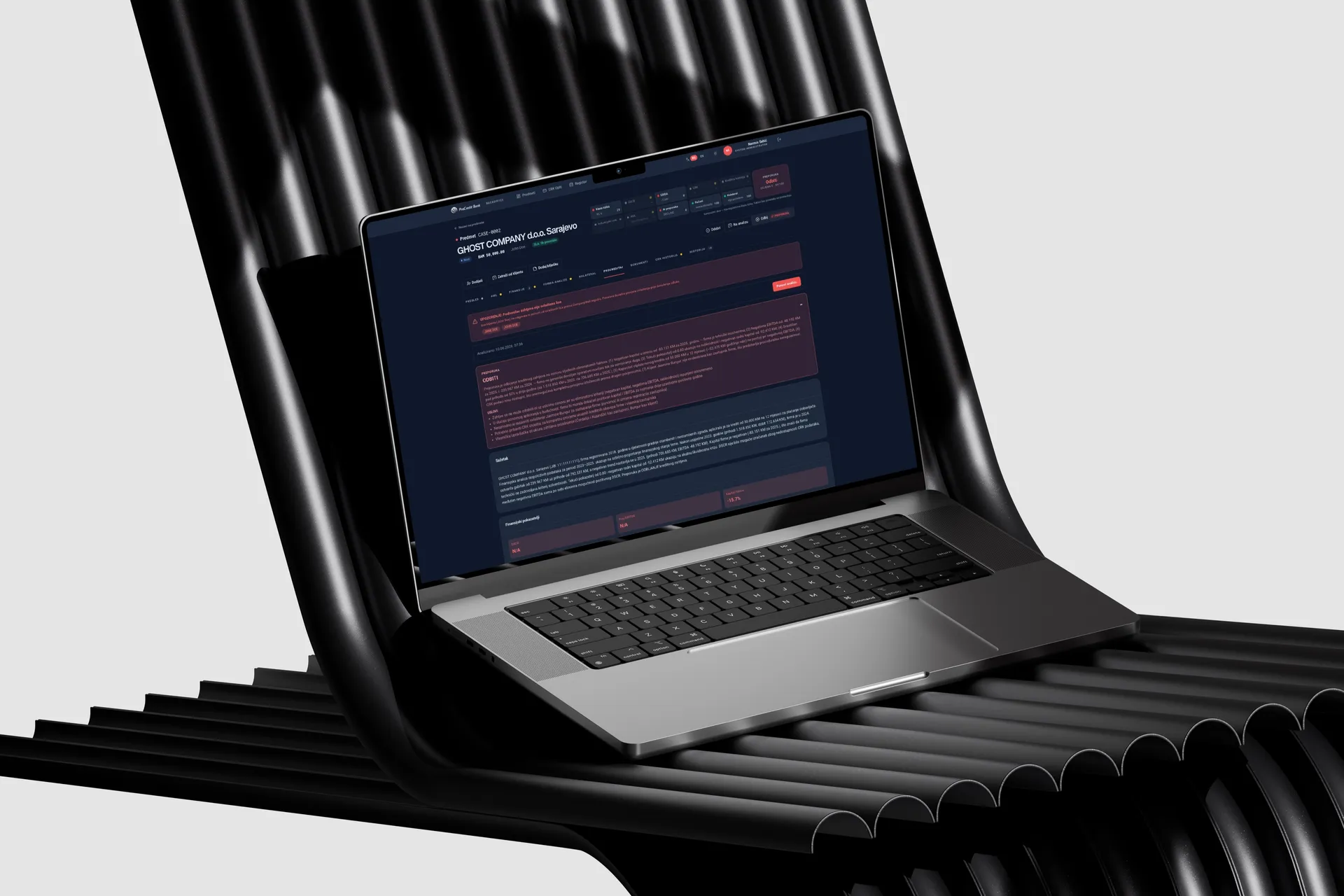
Most of a week disappears between the steps, not inside them. That is where a machine belongs — and where it does not.
This is the shape we found at ProCredit and the shape we expect to find at your desk. On the call we redraw it in your vocabulary, with your systems in the boxes.
Intake and completeness
Read the application and its attachments, flag what is missing, and ask the customer for it through a portal instead of a reply-all email thread.
Registry, court and tax records
Pull the public record on the company and its owners across the official sources — the search LeadHunter already runs across fifteen of them — so the analyst opens a file, not a browser.
Financial statement extraction
Indicators out of PDFs and scans and into the case, each figure carrying the page it came from.
Risk grade and the written reasoning
The engine proposes a grade and writes its reasoning in full. The analyst approves or overrides — and the override is part of the record.
The committee pack
The reasoning travels with the decision, so the pack assembles itself from the case instead of being rebuilt in a slide deck.
The decision
A human decides. The system makes the decision consistent, fast, and explainable to the committee, the customer and the regulator.
Customer communication and documents
Status, requests and signed documents move through a portal and a sealed vault, not attachments — and the customer sees where their application stands.
The audit trail
Every decision, route and document event written once and never edited. Hand it to the regulator as-is.
- Whoever runs SME lending or credit risk
- Whoever owns operations — COO, head of operations
- The CIO, if you want the integration questions answered live
Nobody prepares a deck. Nobody shares data.
You walk us through it
How an SME application moves today: who receives it, what they wait for, where it sits, who signs. The complaints are the map.
We probe
Where the documents live, what the core system exposes, who touches a file before committee, what "good" looks like to credit risk and to the customer.
We call it
The one step worth doing first, roughly what it costs and returns, and a straight answer on whether there is a case here at all.
Does any customer data leave the bank for this?
No. The review is a conversation about how the process runs today — nobody uploads anything. If a Build follows, where the system lives is a scoping decision made with your IT and compliance teams before a line of code is written.
We are a microfinance institution, a leasing company, a factoring desk — not a bank.
The workflow has the same shape: an application, a set of documents, a grade, a decision, and a customer waiting for it. The review is the same hour. Only the vocabulary changes.
Our core banking system is not something you have seen.
Vincu sits beside the core system as the connective layer, on one shared record; it does not replace it. What the core exposes is one of the questions we ask on the call, and it shapes what we recommend first.
What happens after the call?
One of three things. A Roadmap, if several workflows are worth ranking. A Build straight away, if one step is obvious and its data is reachable. Or nothing — and you will have heard that on the call, not in a follow-up email.
Why is it free?
Because the call is also how we decide whether we want to work with you. We turn down work that AI cannot genuinely improve; the review is where that gets decided, on both sides.
Our IT team says they can build this with Claude.
They can probably build the first version, and so can we — we use Claude for it. The review is not about who writes the code. It is about which step is worth automating first, what the regulator will need to see, what the core system exposes, and what it costs to keep running. If the answer is “do it in-house”, we will say so and tell you where the wall is.
One workflow, one hour. Then a price, or a no.
Book the review and bring the person who signs the loans. Or write to the founder directly — he ran the ProCredit engagement and still takes these calls himself.
02 · Roadmap
The board-ready plan
€8K–€15K · ~10 days →